
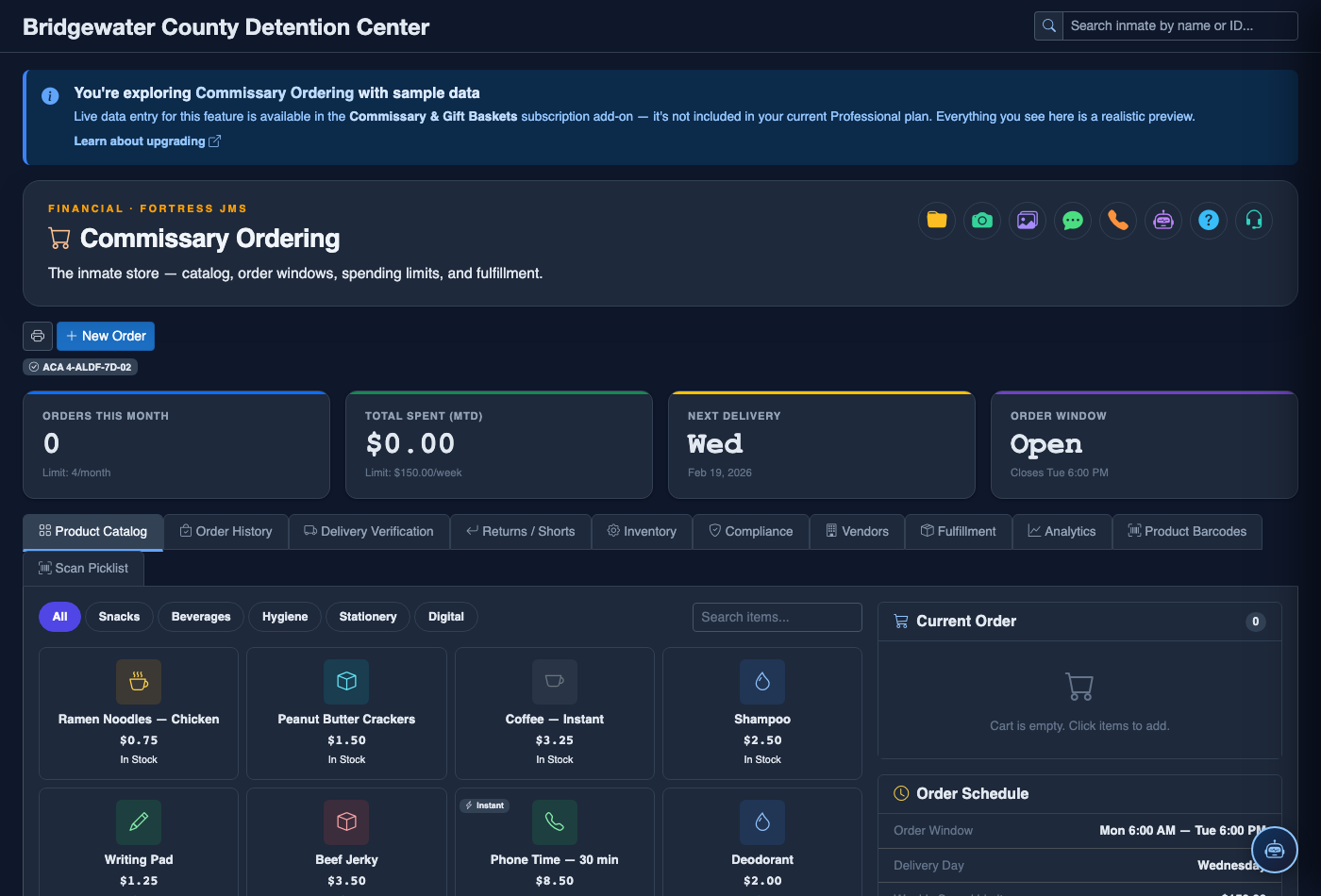
Fortress Commissary turns the weekly commissary day into a fifteen-minute fulfillment cycle. Inmates browse a category-filtered catalog on the Offender Tablet or at the housing-unit kiosk, build an order, and confirm — the order debits their trust balance in real time and lands in the warehouse pick list for the next delivery run. Staff get a single dashboard for orders, dietary conflicts, fulfillment status, and refunds. The same catalog data powers the family-purchased Gift Baskets program, so a “snack lover” basket and a directly-ordered ramen pack come from the same shelf, the same pick list, and the same inventory count.
What it does
- Renders a tablet-friendly catalog of stocked items with photos, prices, and dietary tags. Search and category filters narrow a 300-item catalog to the few items the inmate actually wants in under ten seconds.
- Validates orders against per-inmate spend caps, dietary restrictions (kosher, halal, diabetic, allergy), housing-class restrictions (no glass in seg), and weekly-quantity limits — before the order is even submitted.
- Debits the trust balance through the same ledger used by IPS and Inter-Agency Billing. No separate commissary float, no parallel reconciliation.
- Generates a warehouse pick list grouped by housing unit so a two-person fulfillment team can run the entire facility’s order in one pass.
- Handles refunds and substitutions as first-class transactions with reason codes, supervisor sign-off, and full audit trail.
- Supports indigent-inmate accommodations: facilities can configure a free hygiene/stationery pack that any inmate with a zero balance can request once per week, with full audit of issuance.
- Exposes a per-inmate spend dashboard so a classification officer can see at a glance whether an inmate’s commissary pattern has shifted — useful as one early signal for the intel team and the SAR queue.
How it works
The commissary catalog is data-driven — items, prices, dietary tags, and stock counts live in the FortressDB and are administered from the staff surface. Inmate orders write to the commissary order tables and post a corresponding debit to the trust ledger at confirmation. The dietary-conflict engine runs server-side against the inmate’s medical profile so the conflict is caught regardless of which tablet placed the order. Catalog photos are served from facility-local storage with a CDN cache in front, so even a tablet on a slow housing-unit WiFi loads the catalog in under two seconds.
On fulfillment day, staff print or pull up the pick list, scan items into bags, and mark orders delivered. Delivered status flips the order on the inmate’s history and triggers the receipt in their tablet inbox. Undelivered items (out-of-stock, substitution declined) refund the trust balance automatically. The pick list groups by housing unit, then by order, then by shelf location — so a single pass through the warehouse fills the entire pod’s worth of orders.
Inter-agency holds, federal pre-trial detainees, and county-billed holdees all order through the same surface. When the facility bills the holding jurisdiction for housing days, the commissary spend rolls into the same monthly invoice — visible to the records officer through Inter-Agency Billing.
Data captured
- Per order: inmate id, line items with prices and quantities, total, fulfillment status, delivery officer.
- Trust ledger row debited at order confirmation; refund rows credited at fulfillment exception.
- Dietary-conflict flag with the rule that fired (kosher, halal, diabetic, allergy).
- Audit trail: every status transition with the staff member, time (UTC, displayed facility-local), and reason code.
Compliance & retention
Commissary records are financial records — retention follows the facility’s accounting policy (typically seven years). The ledger is append-only; corrections happen as offsetting transactions, never edits. Dietary-restriction enforcement is captured for ACA accreditation evidence — every blocked order writes a row showing the rule that fired and the inmate profile attribute it matched, ready to hand to an inspector.
Tax compliance: the system computes commissary sales tax per jurisdiction and rolls it into the standard SalesTaxReport. Refunds reverse the tax as well, so the monthly remittance always reconciles.
We switched to a kiosk-based commissary system about eight months ago and the reduction in paper grievances alone made it worth it. My one question — does your dietary validation flag religious diet restrictions automatically, or does that have to be configured manually per facility? That’s been our biggest headache since we have a pretty diverse population.
We switched to tablet-based commissary ordering about eight months ago and the trust-account debit piece alone eliminated probably 90% of our manual reconciliation headaches. My one question — does your system flag dietary restrictions automatically when an inmate tries to order something that conflicts, or does that require staff to set it up on the back end first?
We switched to a kiosk-based commissary system about eight months ago and the reduction in paper order forms alone was worth it — staff used to spend hours sorting those things by hand. One thing I’d love to see addressed in a follow-up post is how the dietary validation handles inmates with multiple overlapping restrictions, like both a medical allergy and a religious diet flag, because that’s where we still run into hiccups.
We switched to a tablet-based commissary system about eight months ago and the biggest win for us was eliminating the paper order forms — staff errors dropped significantly and the inmates actually get what they ordered. Quick question though: does your system handle dietary restrictions automatically at the point of ordering, or does that still require a manual override from medical staff?
We switched to tablet-based commissary ordering about eight months ago and the dietary validation piece alone has saved us so many headaches — no more staff manually cross-checking allergy flags on paper. One question though: does your system handle bulk refund processing when a canteen item gets pulled from inventory mid-week, or does each one have to be reversed individually?
We switched to tablet-based commissary ordering about eight months ago and the biggest win honestly was cutting down the paper grievances over order errors — inmates can see exactly what’s in stock before they order. Quick question though: does your system handle religious dietary flags automatically at the catalog level, or does that still have to be managed manually on the facility side?