
Fortress Gift Baskets gives families a sanctioned channel to send their loved one a holiday, birthday, or get-well care package — without smuggled contraband risk and without the facility staff having to triage Amazon deliveries at the loading dock. Families shop a curated catalog of facility-approved baskets, pay online, and the basket is assembled by commissary staff and delivered to the inmate on the next fulfillment run. The result is a humane channel for family connection on the days that matter — birthdays, holidays, the first week of a long stay — that respects the facility’s contraband control posture and adds a modest revenue line to the commissary fund.
What it does
- Publishes a public catalog (no login required) of facility-approved gift baskets — birthday, holiday, snack, hygiene, stationery, coffee & sweets, and seasonal variants — each priced and described.
- Lets families search by inmate name or PIN, select a basket, pay by card or Apple Pay through the facility’s Authorize.Net merchant account, and receive a confirmation email with delivery ETA.
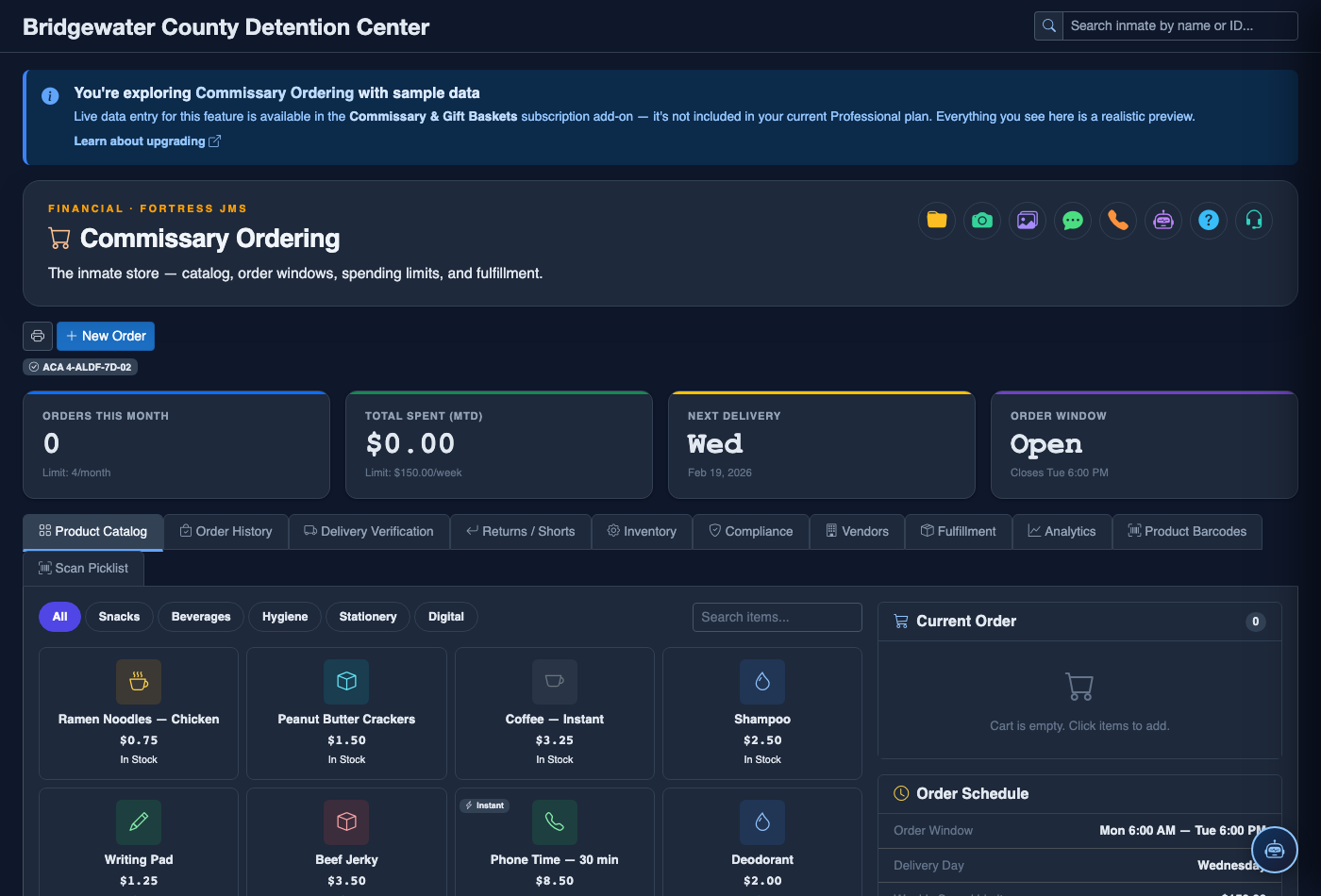
- Routes the order into the commissary fulfillment queue alongside Commissary Ordering — same warehouse, same pick list, same delivery officer.
- Captures per-basket margin for the facility commissary fund — a revenue line that previously leaked to outside vendors.
- Honors the same dietary, classification, and housing-unit restrictions as commissary orders. A holiday basket with peanuts won’t reach an inmate with a peanut allergy on file.
- Surfaces a buyer-facing order-history page so a family member who sends multiple baskets a year (e.g., monthly) can see what shipped, when, and what the inmate’s delivery confirmation looked like.
- Lets administrators publish facility-themed seasonal baskets (Mother’s Day, Father’s Day, Eid, Hanukkah, Christmas, Lunar New Year) and retire them automatically on a configured end date so the catalog stays fresh without manual maintenance.
How it works
The catalog and items live in the jms.GiftBaskets and jms.GiftBasketItems tables. The public-facing shop page (/public/gift-baskets) is anonymous; payment goes through the facility’s Authorize.Net merchant account; the successful order writes a jms.GiftBasketOrders row and enters the commissary pick list with a GiftBasketOrderId tag so warehouse staff know to assemble it from the basket recipe. Catalog administration lives in the staff-side GiftBasketManagement page — staff can publish a seasonal basket in a few clicks, set effective dates, swap photos, and retire a basket without disturbing existing orders that haven’t shipped yet.
On delivery day, the basket is built from its component items, scanned, marked delivered, and the inmate gets the items in their next commissary delivery. The buyer gets a confirmation email with the delivery timestamp; if the inmate has been moved or released, the system catches it at fulfillment-time and refunds the buyer with a plain-English explanation.
Pricing supports facility margin without nickel-and-diming families: a markup percentage is configurable per category, and the system computes the buyer-facing price and the internal-cost split automatically. Margin lands in a separate commissary-fund ledger so the operating account stays clean.
Data captured
- Per basket: name, description, photo, retail price, component items with quantities, dietary tags, active flag.
- Per order: buyer email + name, payment transaction id, amount, inmate id, basket id, fulfillment status, delivery time (UTC).
- Payment audit: Authorize.Net transaction id, last 4 digits of card, decline reasons for failed attempts.
- Refund trail: reason code, refund transaction id, processed-by staff id.
Compliance & retention
Public-facing payment processing is PCI DSS scoped through Authorize.Net — Fortress never stores raw card data. Order records are kept under the facility’s commissary records schedule. The component-items audit ties every delivered basket back to the trackable contents that entered the housing unit, which satisfies the same contraband-control review used for outside-vendor mail. The shipper-side audit log records who purchased every basket and when, useful both for the standard commissary-records subpoena and for the more rare visitor-monitoring investigation.
Public-facing accessibility: the catalog is mobile-friendly, screen-reader compatible, and supports Spanish — the same i18n surface used by Top-Off. Families don’t need a Fortress account to buy a basket; they just need the inmate’s name and the facility’s name.
We rolled out a similar vendor-approved package program about two years ago and the reduction in contraband attempts through mail was noticeable almost immediately. My one question — does your system allow the facility to set blackout periods, like during lockdowns or audits, where families can’t place orders? That was a headache we had to work around manually for a while.
We switched to a vendor-managed care package system about two years ago and it genuinely cut down on the contraband headaches we were dealing with at mail intake. My one question would be whether your catalog approval process allows facilities to customize which items are permitted, since our population has some specific restrictions around certain food items due to allergies.
We switched to a vendor-managed care package program about two years ago and the contraband issues we were seeing with hand-inspected mail packages dropped significantly. My one question is whether facilities can customize which product categories are available — we’ve had requests for hygiene-focused bundles but want to exclude anything with foil packaging for our specific housing units.
We switched to a vendor-managed care package program about two years ago and it genuinely cut down on contraband attempts dramatically — families appreciate having a legitimate option and staff aren’t spending half their shift inspecting outside packages. Curious whether your system integrates directly with existing commissary software or if it runs as a standalone catalog. That piece is always the sticking point for us when evaluating new vendors.
We rolled out a similar vendor-approved package program about eight months ago and the reduction in unauthorized items coming through visitation has been noticeable. My one question is how your catalog approval process works — do facilities get to customize which items are allowed, or is it a standardized list across all sites?
We rolled out a similar vendor-approved package program about two years ago and the reduction in contraband attempts at the mail room was pretty significant — families appreciate having a legit option. Quick question: does your system allow the facility to update approved items in the catalog on the fly, or does that require going back to the vendor each time?